
Magnesium: Why Form, Testing, and Timing Matter More Than Hype
The Magnesium Paradox
There are four main macro minerals that your body needs in balanced amounts to function optimally: Calcium, Magnesium, Sodium, and Potassium. Each of these is equally important in its own right, but we hear the most about how much we need magnesium and calcium, how much we should get less sodium, and not a heck of a lot about potassium.
The truth is, even a well-balanced healthy diet will struggle to meet the minimum amounts of each of these minerals and also the RDA for vitamins and trace minerals.
We have our over-farmed, depleted soils to partially thank for that, and also, the abundance of processed food consumption as the majority of the population tend to seek convenience over nutrient-density.
That said, the fairly recent attention magnesium specifically has gained is due to more research revealing how important it is and how deficient we all are.
Magnesium is necessary for calcium absorption, enzyme function, nervous system regulation, muscle relaxation, and blood sugar stability. If you stop and think about what happens when these systems break down, it's clear how those symptoms are manifesting in anxiety, tension, poor sleep, low energy, and inefficient digestion.
With the promise of taking a magnesium supplement to counter these symptoms, supplementation has become more popular within the masses.
Blood pressure studies show proper magnesium supplementation reduces both systolic and diastolic pressure in women with mild to moderate hypertension. So there is benefit here we cannot ignore, but it has to be tackled thoughtfully.
Folks are clicking on ads, trusting their favorite influencers, and investing in what they expect to be the right, quality magnesium supplement without knowing if it's the optimal form for their needs or how to dose it properly.
We are indeed deficient in magnesium, but different forms serve different functions, and most people aren't knowledgeable about which form does what. Not to mention, without a Hair Tissue Mineral Analysis to identify what the imbalances are, (if any!), you are playing a bit of supplement roulette.
The problem isn't supplementing with magnesium, it's matching the right form to the person and the situation.
Why You Can't Just Look at Blood
If you rely primarily on blood tests to inform your macro and micronutrient balance, it's super important to bear in mind that you're not only getting a brief snapshot of what is currently circulating at that moment, but the very nature of blood is to seek homeostasis.
That means, when there is too much of a substance in the blood, it will quickly get pushed into the body tissues and organs. And if there's not enough? You guessed it--it will draw what it can from the tissues. Normal results on blood range tests can easily hide a legitimate tissue depletion. Using the RBC (red blood cell) magnesium marker is more reliable than serum, but still limited.
The only time it will seem like a macronutrient like magnesium or calcium is too low in the blood, you're probably in a really bad way with an acute disease state. The levels can show up slightly out of range, which can provide information by it's own right.
Blood magnesium represents only about 0.3% of total body magnesium; 30-40% lives in tissues.
HTMA can tell us if you're truly deficient in the minerals. It provides a 2-3 month progression of your mineral status, not a moment in time, like blood.
HTMA markers that signal magnesium need include:
low calcium
high Na/K ratio
phosphorus below 16 (protein assimilation issue)
iodine imbalance markers
copper burden
Functional blood chemistry (RBC magnesium, serum magnesium, and markers like sodium/potassium ratio) analysis paired with HTMA provides the full picture of what is being utilized, stored, depleted, and/or in balance in the body.
Forms of Magnesium and What They Do
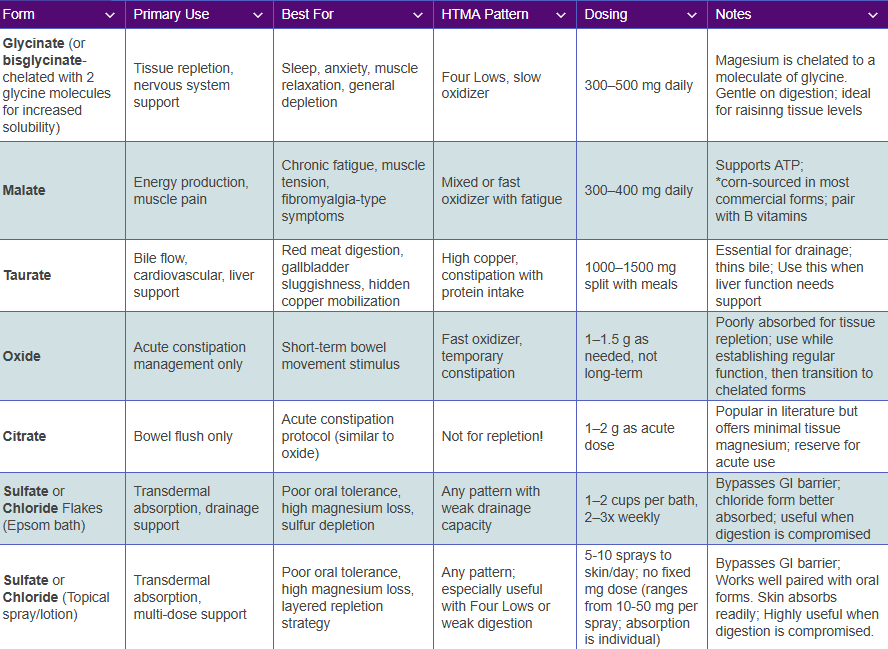
The table below breaks down each of the forms you are most likely to see. No, this isn't exhaustive! There are so many forms of magnesium! Magnesium Threonate, for instance has gotten lots of fan fare for improving cognition and brain function because of its ability to cross the blood-brain barrier. I left it out because there isn't data on how effectively it replenishes tissue stores of magnesium.
However, it could be inferred that if it crosses the blood brain barrier and is take up by the brain organ, that it should also be able to do that at the basic cellular level of other body tissues. For now, I am focusing on the most studied and reliable forms:
(Quality and form matter: seek amino acid chelated forms or food sources; avoid fillers and oxidized forms)
What HTMA Reveals About Magnesium Need
There's a reason why in the functional health world we harp on the phrase, "Test, don't guess!" So many symptoms and conditions overlap but have markedly different causes. We can "guess" at what the cause is (and many good practitioners can be quite good at this with experience and intuition) but being your own guinea pig can come with unwanted consequences.
If you get it wrong, you may end up suffering more.
For instance, if you don't know the difference between what forms of magnesium do what and order a blend on Amazon that has ALL the magnesium forms, (and is indeed bragging about this feature), you may exacerbate a digestive issue when all you want to do is get better rest and nervous system regulation.
Magnesium oxide doesn't get absorbed. But it pulls water into the digestive tract to help stimulate the bowels. Not everyone needs that. More doesn't always translate into better.
When you opt for HTMA before messing with your supplement regimen you can find some interesting things out about your body's efficiency:
High magnesium on HTMA often indicates a loss (not excess), meaning, the body is mobilizing it due to stress, low calcium, or mineral dysregulation. It doesn't mean you're getting too much or that you have enough reaching the tissues.
Low magnesium paired with low calcium suggests depletion. Add low sodium and low potassium to the mix and you're in a Four Lows pattern which is as depleted as it gets. (Think moms after a year of sleep deprivation with an infant)
Hidden copper, high sodium/potassium ratio, and over-functioning adrenals all increase magnesium demand
Magnesium can mask as "in range" when it's functionally depleted; relate it back to symptoms (fatigue, muscle tension, poor sleep, agitation). This is why you need a skilled interpreter.
How To Properly Dose Magnesium
Once you know what is going on in your own bioindividual situation, there is a gentle approach to maximize benefit and minimize side effects.
Start slow and low-- Especially if sodium is depleted or adrenals are burned (magnesium lowers sodium further). Keep sea salt in the rotation. If you know the adrenals need support consider adding an adrenal cocktail regimen. This is where balance is necessary and the understanding that "more" isn't always better.
Dosing range: Generally 150mg for every 50lbs of body weight a day. 300–400 mg per day for most adults; adjust based on HTMA pattern, bowel tolerance, and how you feel.
Bowel tolerance: too much magnesium causes loose stools, which is how the body signals "enough". Again--balance.
Timing: Take with food when supporting digestion and bile (in other words, if constipation or loose stools are an issue);
Don't neglect the other minerals: Pair magnesium with adequate dietary calcium, sodium, and potassium to prevent ratio imbalances. We want to gain as much of these minerals from food as possible. Most people are not endeavoring to do this.
When Testing Should Come First
Without HTMA or functional blood work, you're guessing at whether magnesium is actually the problem.
If you suffer with fatigue, muscle tension, and constipation, you probably need magnesium OR you might need potassium, sodium, calcium, or digestive support. Without testing we really are only guessing!
Testing prevents over-supplementing (which can lower sodium unnecessarily and cause a new host of issues), under-supplementing (missing the real driver), and supplementing the wrong form.
Even a basic blood panel (serum and RBC magnesium, sodium, potassium, calcium) provides valuable insight and clues into what is happening at the cellular level. Paired with HTMA we get the full picture and you can confidently move forward with informed choices.
The Magnesium Hype vs. Reality
Magnesium isn't a miracle supplement.
It's a foundational mineral. We ALL need it for proper cellular functioning. And supplementing with it only works when the full mineral picture is balanced.
Furthermore, we should always prioritize getting our minerals from food first. If we could get everything we need from swallowing pills or mixing powders, we would never be hungry for food.
Optimal nutrient assimilation requires the myriad of factors provided only by food:
Enzymes. Raw and lightly cooked foods deliver active digestive enzymes: amylase, protease, lipase. A supplement can concentrate one or two; food gives you the full spectrum working together. Once food is processed into a supplement, most enzymatic activity is already gone.
Fiber. Soluble and insoluble fiber from whole foods feeds your microbiome, slows glucose absorption, and supports bile recycling. You cannot supplement fiber in a way that mimics what actual food does in the gut.
Phytonutrients and polyphenols. Thousands of them: anthocyanins, catechins, flavonoids, carotenoids. These are not minerals or vitamins; they're plant compounds with antioxidant and anti-inflammatory action. A supplement cannot capture the full spectrum of what's in a handful of berries or a bunch of dark leafy greens.
Cofactors and synergistic pairs. When magnesium appears in pumpkin seeds, it arrives alongside zinc, manganese, copper, B vitamins, and fiber. When iron comes from spinach, it travels with folate, vitamin C, and oxalates that regulate absorption. Whole foods package nutrients in ratios that evolution has already optimized; isolated supplements cannot replicate this.
Water-soluble compounds and volatile oils. Garlic, onions, ginger deliver sulfur compounds and essential oils that are lost in processing. You can take garlic powder, but fresh garlic is biochemically different.
Amino acid profiles and cofactors. A supplement of magnesium glycinate gives you the chelate; bone broth gives you magnesium, glycine, collagen, proline, hydroxyproline, and peptides your body uses directly for tissue repair. The whole food is denser and more bioavailable than the sum of its parts.
Nutrient density and mineral ratios. Whole foods come packaged with the precise ratios of minerals needed to prevent antagonisms. A multimineral supplement attempts this, but soil depletion and processing often skew the ratios.
Real food, especially locally raised and grown, carries better mineral balance than any supplement every could.
Most people fail to eat enough because they underestimate portion sizes and frequency needed, and because modern processed food is nutrient-depleted. A supplement fills a gap; it doesn't replace the work of eating well. The two work together, not as substitutes.
Foods that are high in magnesium include:
Leafy greens, especially spinach, kale, and chard,
cashews, seeds (pumpkin, sunflower, sesame, flax)
Dark chocolate, almonds, pine nuts, broccoli
How To Proceed With Magnesium
I hope a deeper understanding of magnesium forms, needs, and assimilation into the tissue has persuaded you that a baseline test before willy-nilly supplementing is the most efficacious course of action.
I'm willing to bet that you've got more in your medicine cabinet that magnesium, (if you've already purchased it). And truly, when it comes to ALL of it, we are playing with fire when blindly taking supplements as if no harm can come to us:
Vitamin D is a hormone. Yes, many people are deficient, but supplementing here without understanding how D is converted and synthesized in the body or knowing whether your body is doing any of that properly can end in a magnesium deficiency and compounded issues.
Standard multivitamins rarely contain therapeutic doses of any of the minerals, and usually not enough of the vitamins that we need (that we should still be obtaining from diet first!). The exception here is B vitamins which usually are in high abundance (if not in the most bioavailable methylated forms) because they tend to provide more impact that is measurable. (Which makes you think your multi is awesome!)
Moreover, if you are taking in more of a mineral or nutrient than you need, again, you are creating a new issue. Copper is the biggest culprit here. It's very complex and we should never take excess copper without knowing our copper status and clearing abilities.
When it comes to adding a new element to your regimen, like magnesium, it's possible you could take your chances and do just fine, if not much better. I hope that for everyone!
But after working with people in various circumstances and in different roles over the course of 25 years, I can say with certainty, only about 5% of folks are tuned in to their bodies enough to detect if what they are doing is helping or harming. And even fewer understand enough about physiology and body chemistry to make the most informed choices in the first place.
When you opt for an HTMA, you will find out:
Do I actually need magnesium?
Which form?
How much?
What else am I missing?
Rather than view testing as an added expense, see it as the compass that prevents guessing, that will ultimately save you money in the long run in wasted supplement purchases.